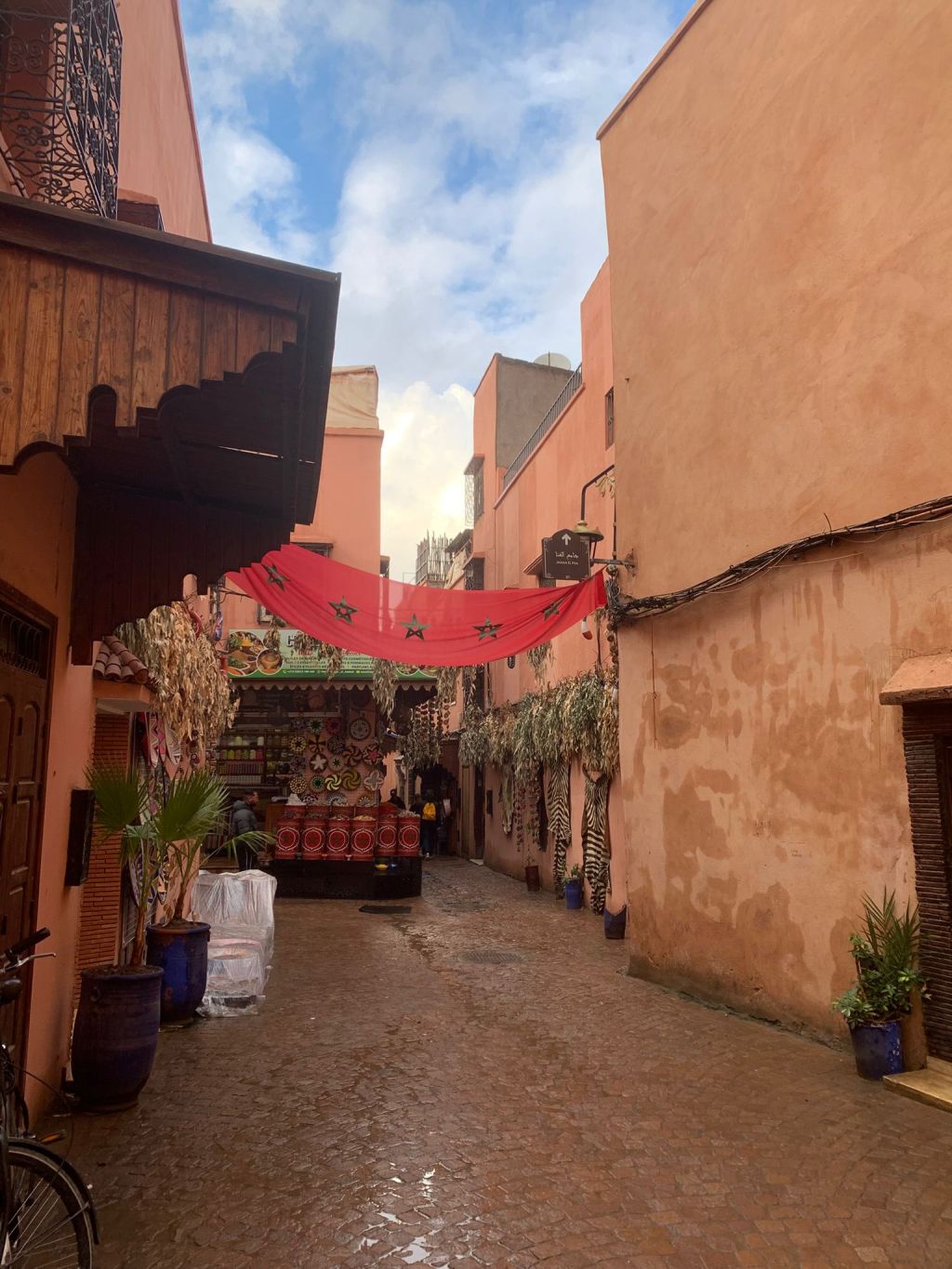
Marrakesh (or Marrakech) is probably the most well-known city in Morocco, despite being the fourth-largest in the country. We visited in January on a trip, ticking of Marrakesh, Tangier (Tanger) and Fez (Fes) too. In this post, I’m going to be sharing my experience in Marrakesh so that you have everything you need to plan your holiday there.
Marrakesh is certainly a historic city; it was thought to be have been founded in 1050 by the Almoravids. It was during this period that the red walls were built which is why Marrakech is often referred to as “The Red City”. Skipping forward to 1912, parts of Morocco were ruled by the French until they gained independence in 1956 when the Treaty of Fes was dissolved. However, France’s influence remained as they still had soldiers stationed in the country and were allowed to have their say on foreign policy. The final soldiers left as recently as 1961. Other areas of Morocco, towards the Gibraltar Strait, were Spanish protectorate until around the same time.
Language
Especially in Marrakesh, you still see the influence of France in the language spoken. Before we arrived, I had assumed that Arabic would be primarily spoken with a little bit of French but we found the opposite to be true during the trip. I have spoken before about how I have a nut allergy and for this trip I bought Equal Eats translation cards in both Arabic and French.
Accommodation
This apartment is the one we opted for and I would highly recommend it. It was two bedrooms and in a great location. It wasn’t too far away from the centre and the attractions like Jemaa el–Fnaa Square but, far enough away to be slightly quieter during the evenings. Thin walls do seem to be common in Morocco – probably because of the heat of the summer, so do expect some noise. I’d highly recommend this AirBnB. Our main criteria was to have kitchen facilities because of my allergy and this ticked that box too.
Getting Around and Experiencing the Traffic
Marrakesh and all of the main sights are very walkable. However, you do have to be on the look out when walking down the streets as mopeds and motorbikes do tend to use the narrow streets quite quickly. You can see why so many people use them as they are really the only vehicle that will fit! Then, on the main roads, the rules are very different for cars than they are in the UK. Partly because, there doesn’t really seem to be any consistent rules at all. When crossing roads, you need to be fairly forward and try to encourage the cars to stop for you. Usually by seeing a small gap and making your way across the road, forcing them to stop. Of course, do this safety but, if you’re waiting until someone let’s you cross, you’ll be waiting a long time.
Other than on foot, the main way to get from places like the airport is either the bus or a taxi. We opted for a taxi as this is easy to do straight outside the main building. The taxis are clearly signposted and there is a booth that you can book at, so it’s all very official. We used the payment machines and all you need to do is type in your accommodation, amount of people and luggage, pay and then you receive a ticket with the number of your taxi. The numbers can be found on the side of the cars and you’re ready to go. As I said, there are very little road rules and being a passenger is an experience in itself! I don’t think I could adequately describe what it was like to you but, one example is when five lines of cars were all trying to get through one single archway. The technique was to inch forward when any gap appears and force yourself forward until others have no choice but to let you through. It’s quite chaotic and I’d recommend getting a taxi at least once just for this reason!
Our Itinerary
Day 1: Arriving in Marrakesh
I am going to skip over some of our first two days in Marrakesh and that’s mainly because we didn’t do anything. Unfortunately, Alex wasn’t feeling very well when we landed and, as we knew we had plenty of time on this trip, there was no rush to push through. Better for him to recover and then be able to enjoy the rest of the holiday properly. Luckily, it was only a couple of days of illness and then he was ready to explore.
So, we arrived in Marrakesh at the Marrakesh Menara Airport from London Stansted on a RyanAir flight and it was already an interesting start. We followed everyone else off the plane and then walked into the building but, to do so you needed to walk around the corner with other people who were queueing to get onto their flights so it was a little confusing. The people waiting to board had airport workers with them in high-vis so were able to direct our flight on how to get into the building. It’s an unusual way of doing it but, once we were in it was fairly simple. Passport control was quick and easy and, as we only took hand-luggage, we were ready to go.
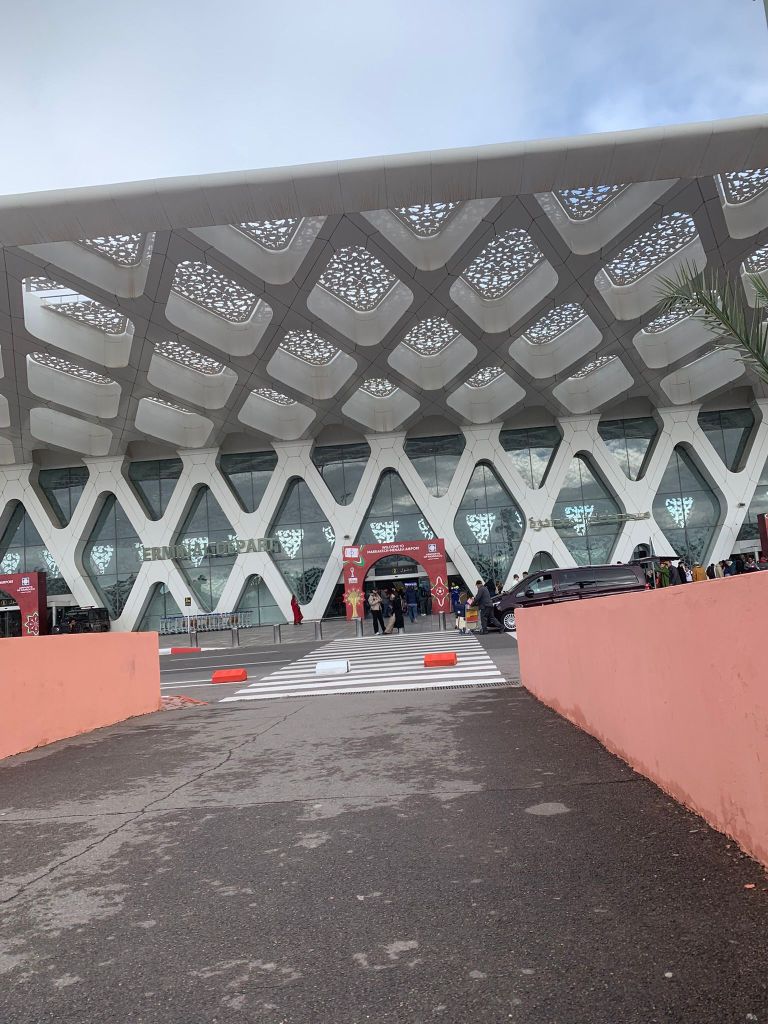
First, we opted to get a SIM card so that we could use Google Maps to navigate whilst we were there. Neither of our providers offered any sort of coverage in Morocco and it would have cost quite a lot of money. I used Orange because I had heard of the company before which in all honesty probably meant that it was more expensive than the other two mobile networks in the airport. It cost 200 dirhams which is around £16 (January 2026) for 20-30GB of data, I can’t quite remember which. It was plenty enough for a one week trip to the country anyway.
We then used a taxi as I’ve spoken about above to head into the city to our accommodation. The taxis often can’t take you straight to the door because of the narrow streets and so we had a few minutes walk to the AirBnB. The simcard already came in handy here and we made it easily to the place and checked in.
The last thing to do was get something for dinner. We found a nearby supermarket, a shop called BIM. There was no fresh food in the shop but, we could pick up enough to make dinner for the duration of our trip. The nearest Carrefour, the larger supermarket chain in Morocco, was too far away and would have required a taxi or bus to get there. BIM did the job during the trip with dried food like pasta and couscous and tinned food such as peas, sweetcorn and tuna.
Day 2: Exploring Marrakesh – Things to Do and See
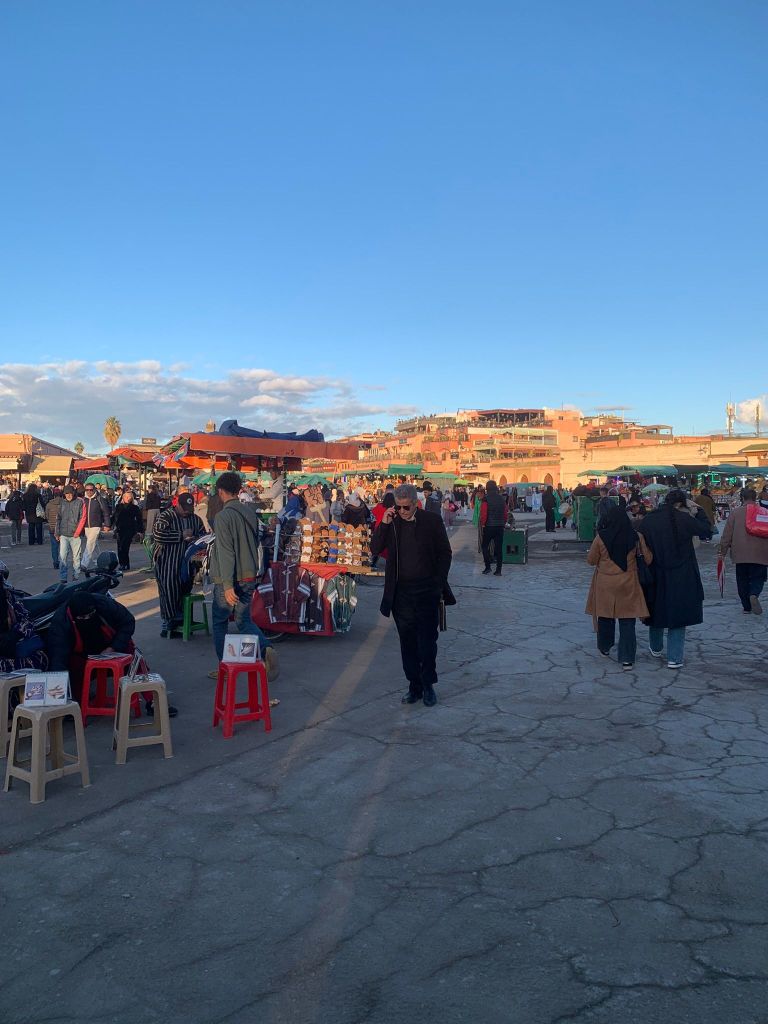
Our first full day of exploring Marrakesh began with a walk to Jemaa el–Fnaa. This was about fifteen minutes or so from our accommodation and included experiencing some of the traffic that I talked about earlier. Crossing the roads was an interesting experience but you soon get used to being more positive and forcing people to stop. You really do need human wing mirrors to see the motorbikes on the smaller alleys though! The square is a bit of a cultural hub as well as a place to visit the markets. Here, you’ll see snake charmers and men with monkeys on chains as well as juice stalls and merchants selling things like umbrellas or sunglasses. The square really does come alive on an evening and we returned later in the day to see the square full of restaurant stalls with sheep heads and other interesting local cuisine. They do smell quite nice but I imagine my stomach would not have thanked me for it the next day. There are people outside each stall trying to get you in to eat and they could be a little pushy but most did take no for an answer.
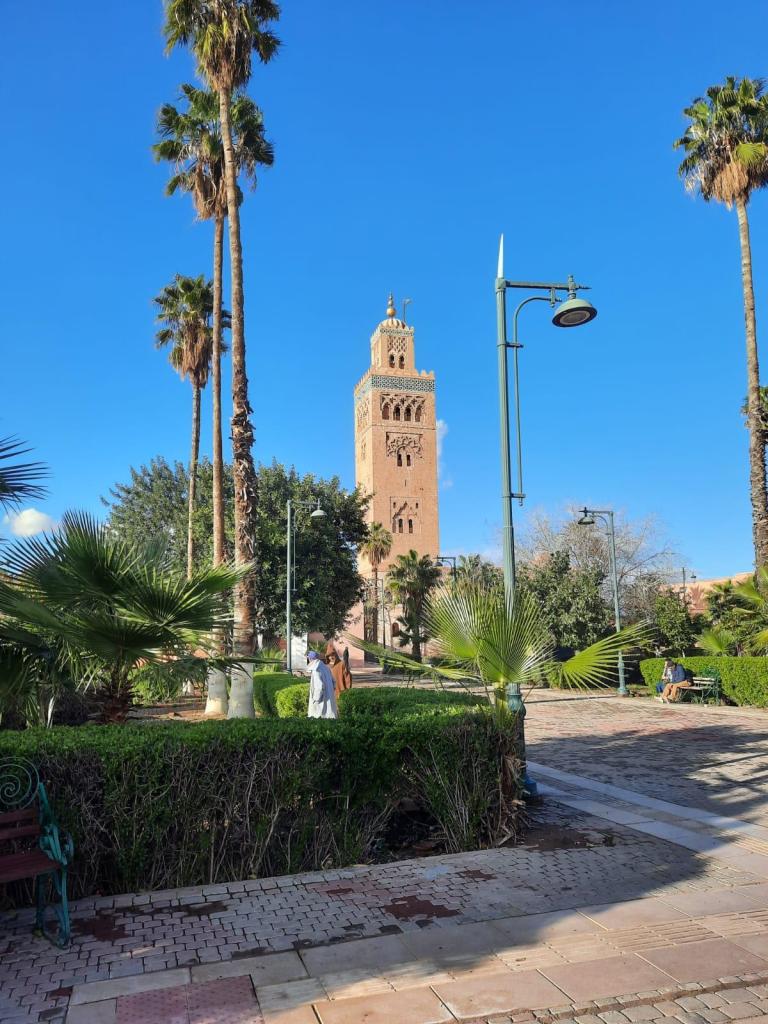
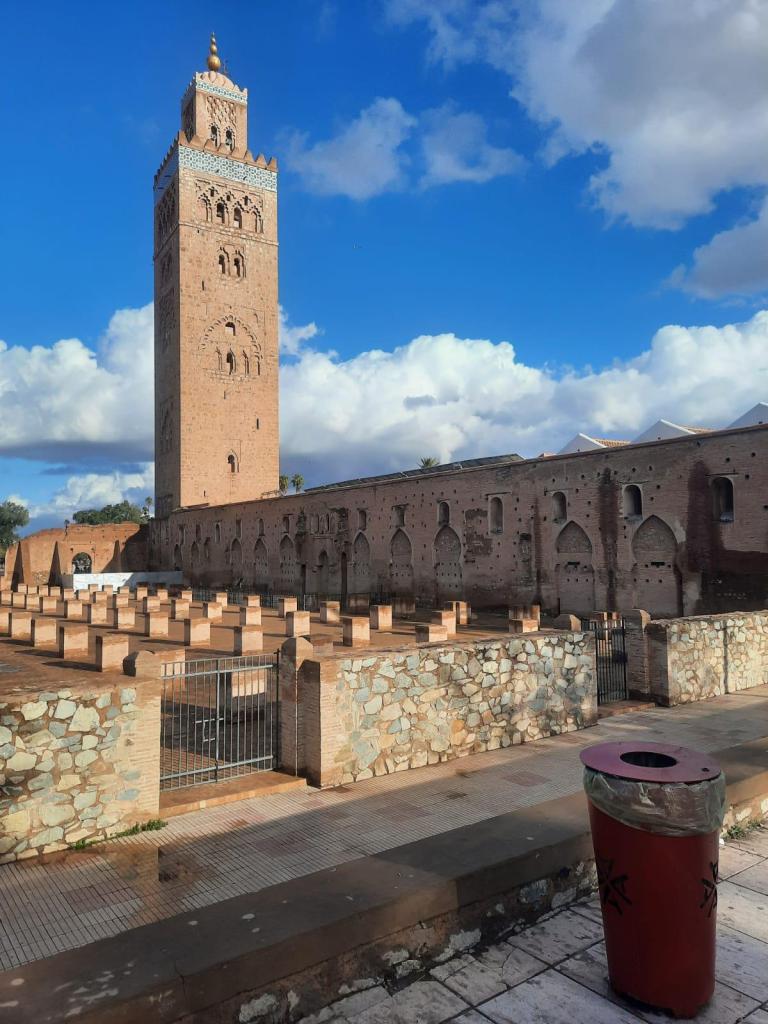
Just off the square is the Koutoubia Mosque which is the largest mosque in Marrakesh. The mosque was founded in 1147 however, the structure was entirely rebuilt between 1150 and 1190 which is how it appears today. At 77m tall, this is the highest building around and is a key landmark in the city. The mosques in the city are all adorned with speakers which are used for calls to prayer five times a day. These begin as early as 5am (they’re dictated by where the sun is in the sky) and are unlike anything you hear in any Christian countries. The calls are supposed to remind those of the faith that it is their duty to worship and also share a sense of community (source).
Surrounding the mosque are some beautiful gardens with orange trees and a lovely fountains. These gardens are the perfect escape from the hustle and bustle of the streets despite still being in the city centre. We really enjoyed walking around here and you always get a great view of the mosque and the Atlas Mountains outside of the city too. I’d definitely recommend taking some time here.
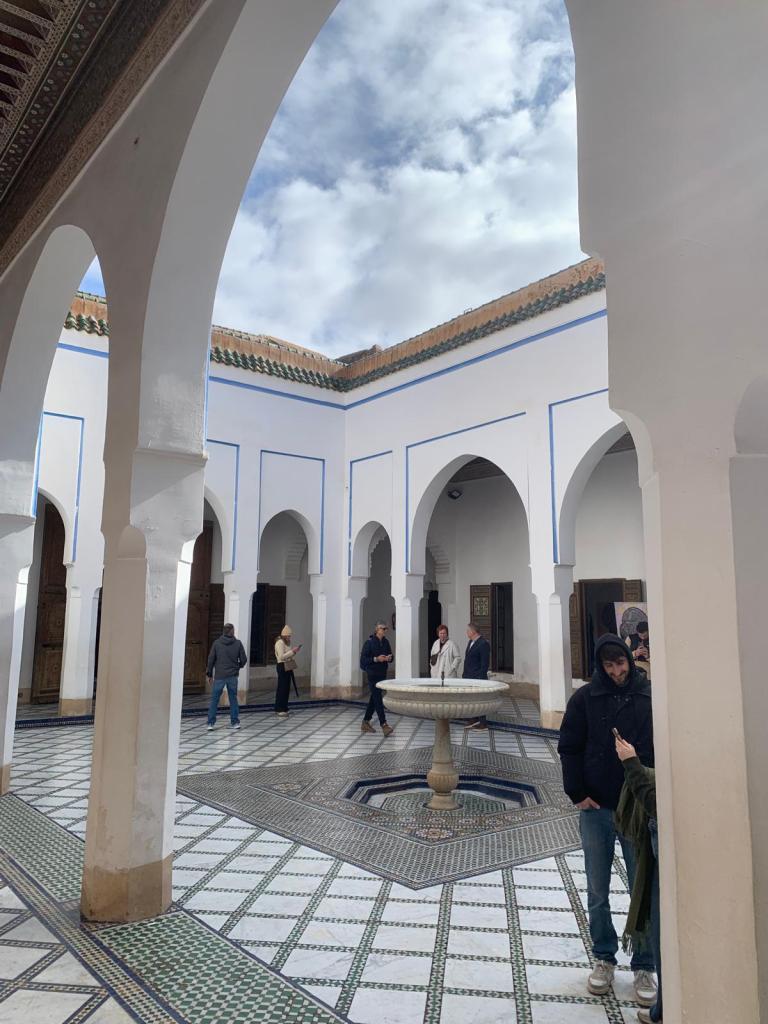
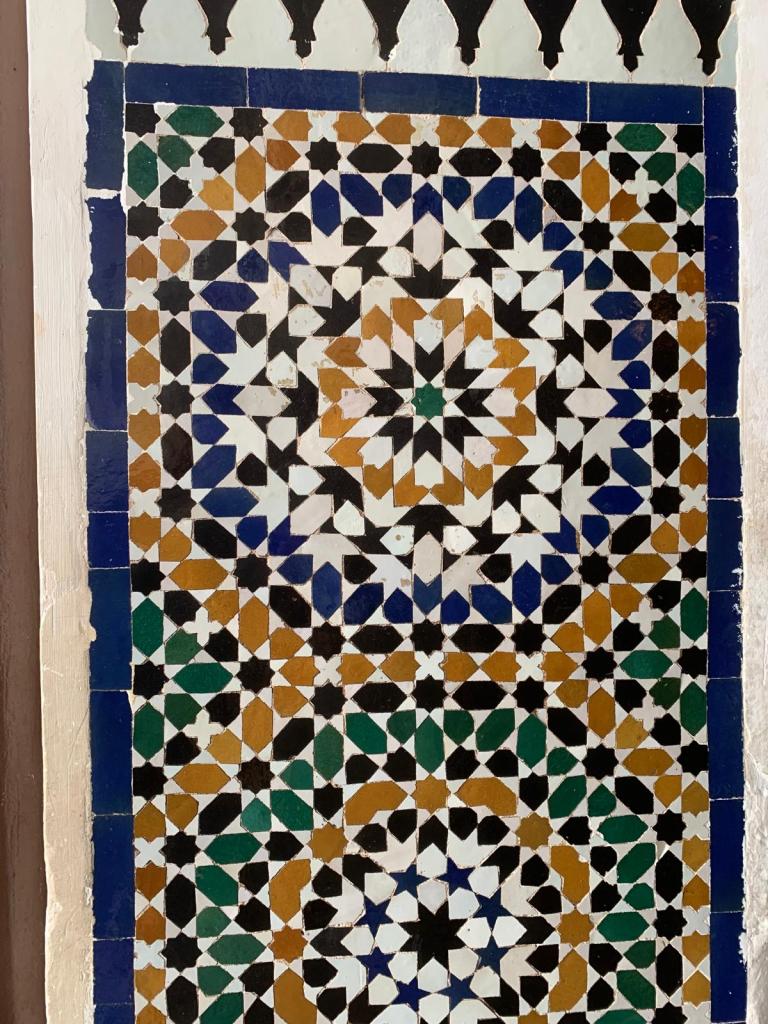
Next, it was time to explore the two main palaces in Marrakesh. We’ll start with my favourite of the two: Bahia Palace. Thought to have been built in the mid to late 19th century, this palace was built for Si Musa, grand vizier under the Alawi sultan Muhammad ibn Abd al-Rahman. With over 150 rooms, the palace is quite large with many courtyards and gardens within it. For 100 dirhams per adult, you can explore these for yourself. I really loved this! The architecture is incredible with ornate ceilings and beautiful tiling throughout. Sadly, the palace was quite damaged during the earthquake in Morocco in September 2023 and so was closed for a while. Some of the areas were under construction during our visit and I do wonder if these were parts still awaiting repair. Nevertheless, I’m really glad we paid the entrance fee and went inside.
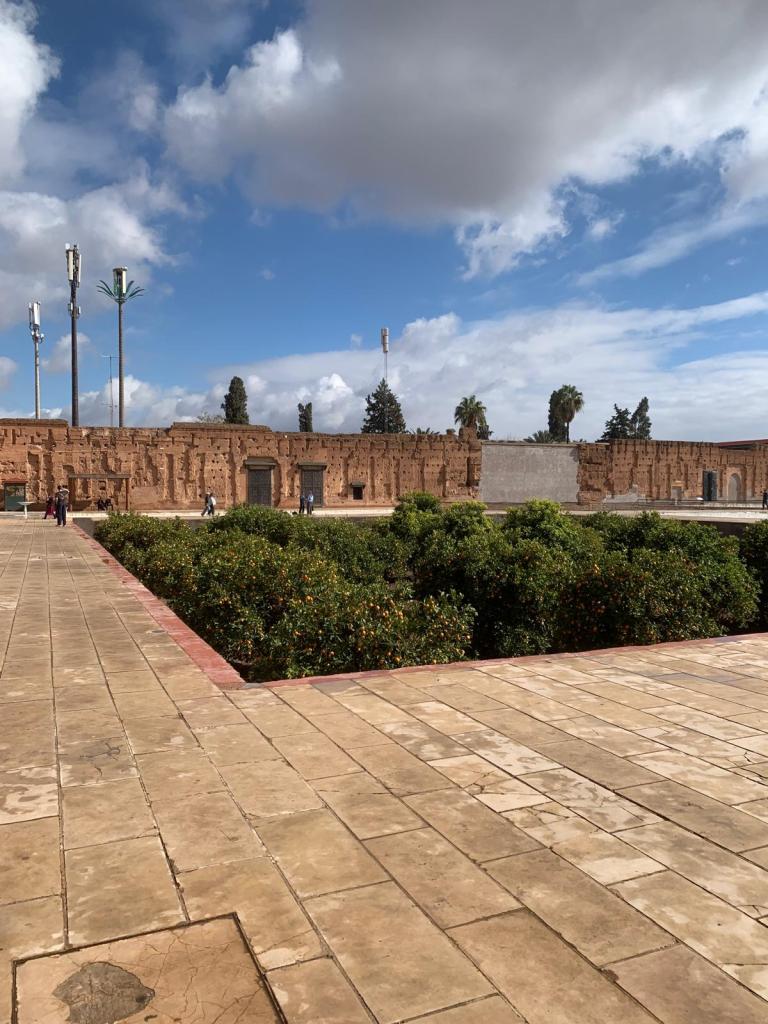
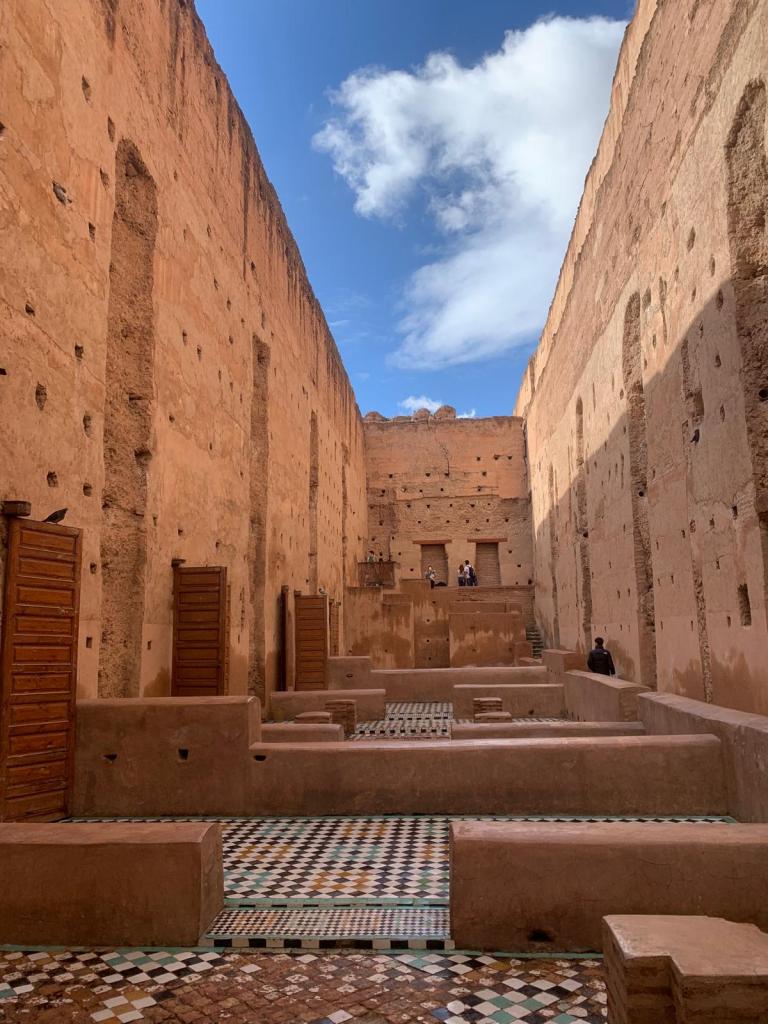
If you’re looking for a more historic palace to explore, the El Badi Palace was built in 1578 by the Sultan Ahmad al-Mansur, the ruler of the Saadian Dynasty. It was supposed to act as a symbol of the power and wealth of the Sultan by mixing a combination of European and Moroccan styles. Back then, it would have been decorated in a much more ornate way with more mosaics and marble columns. A lot of these materials were stripped away and used elsewhere when the palace fell into disrepair following the fall of the Saadian Dynasty and so, the palace you see today is quite different. Unfortunately, a lot of this history had to be learnt after our visit as all of the information boards in the museum itself were in Arabic and French only which was a shame. This did hamper our visit slightly but, it was still interesting to see the inside of the palace itself and the large courtyard in the middle.
One of the highlights of visiting the El Badi Palace was seeing the storks nesting around the edge of the building. These large birds migrate to Morocco from Europe for the winter and are seen as a symbol of good luck and fertility in the local culture. Make sure to look up as you walk around the courtyard and as you’re walking around the Kasbah district as you’re sure to spot them. Like the Bahia Palace, this one also costs 100 dirhams to enter. If you’re going to pick one, I’d recommend the Bahia Palace but, if you prefer more historical architecture then this may be the one for you.
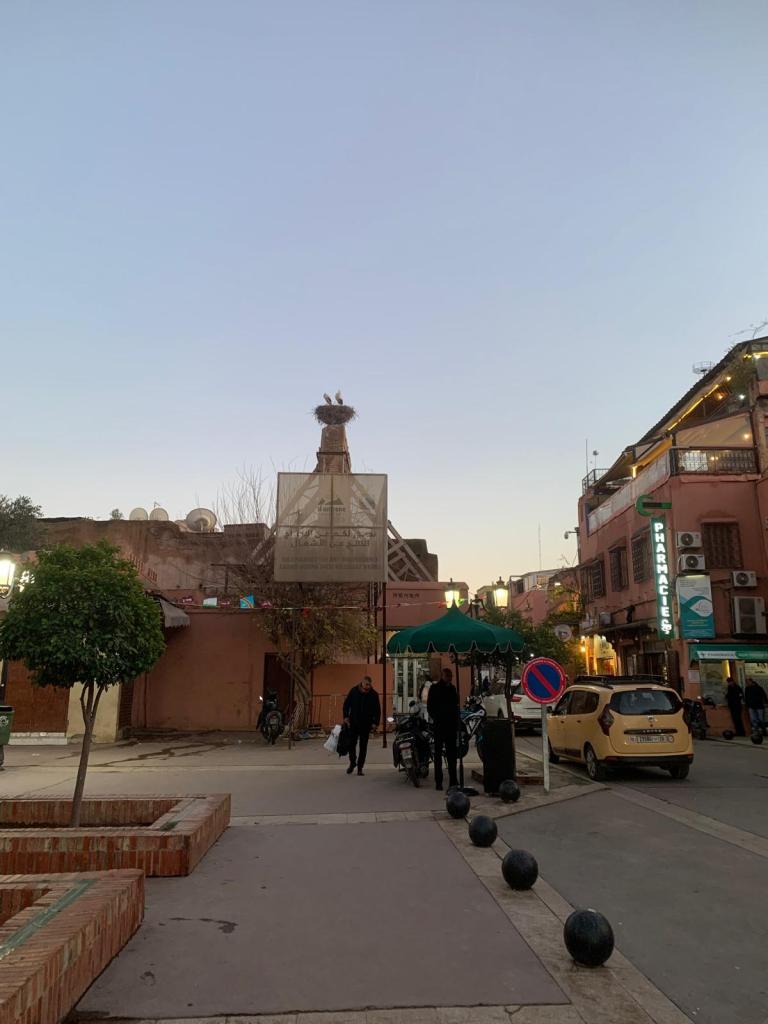
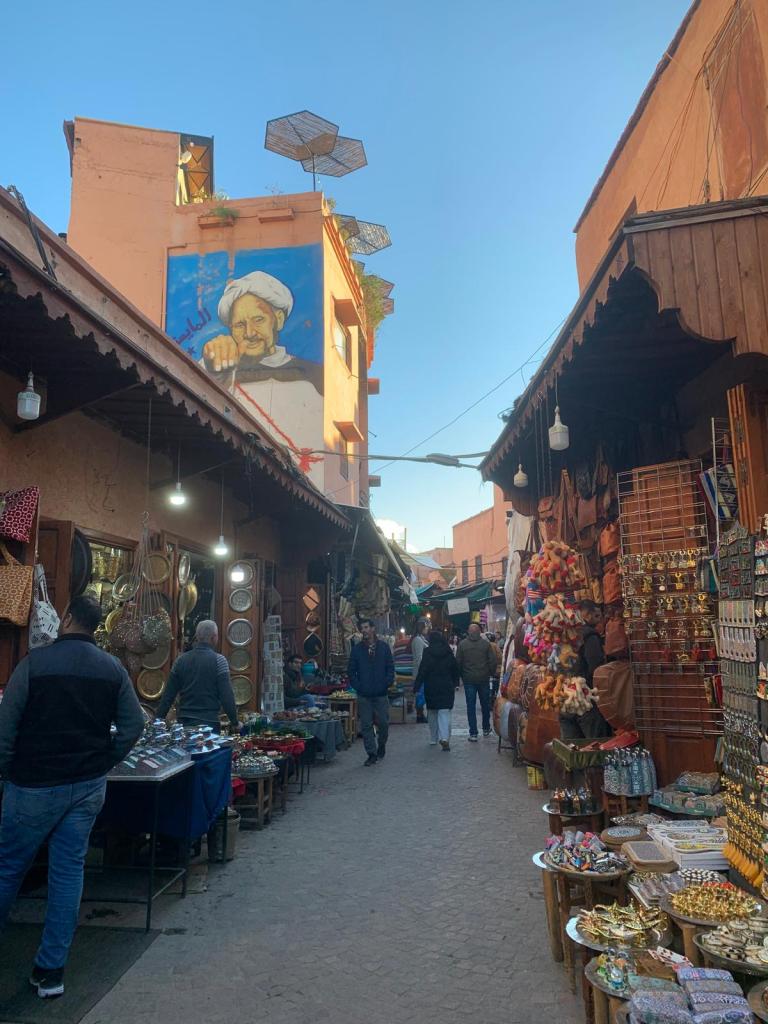
Finally, the real main attraction of Marrakesh and Morrocco in general is spending time in the Souks. These are small, narrow streets with shops either side that spill out on the street. They’re full of pottery, ceramics, slippers, food, and other touristy bits too. You can very easily get lost down them! Vendors try and get you into their shops and haggling is also a big part of the culture. Don’t expect there to be price tags on things and, if there are, they are usually negotiable. It’s such a different experience to what we’re used to at home that it really is the main ‘sight’ so to speak.
Do have your wits about you and keep track of where you are as it’s easy to be taken advantage of. Oftentimes, if someone is offering you directions or telling you which way to go, they will either ask for money once you get there, or take you the wrong way and again, take your money. Alex and his brother, George, visited Marrakesh in 2020 and followed some men down an alley who were giving them directions and lost quite a lot of their cash. I don’t say this to put you off but it’s something to be aware of.
Day 3: An Excursion to the Ourika Valley
One of the most popular excursions from Marrakesh is a trip to the Ourika Valley which includes a scenic viewpoint of the Atlas Mountains, a visit to a Women’s Cooperative that makes argan oil products and a walk to some waterfalls. As we felt we’d seen quite a lot of Marrakesh city the day before, we opted to book onto one of these tours for our final day. We picked one on Get Your Guide but there are loads of them available and I’m pretty sure most of them do the exact same things. Our day included all that I mentioned above and throughout the day we came across many small minibuses doing the same.
We were picked up from one of the main roads near our accommodation in a minibus and then the first stop of the day was a viewpoint of the Atlas Mountains. Personally, I think this was a little ‘oversold’ as a scenic viewpoint. It was next to the main road and we were pretty much looking away from the mountains and looking towards not all that much. On each of these viewpoints down the road, chairs and frames had been erected that were very much prepared for getting photographs. It was fine but, we definitely got better views of the mountains throughout the rest of the day.
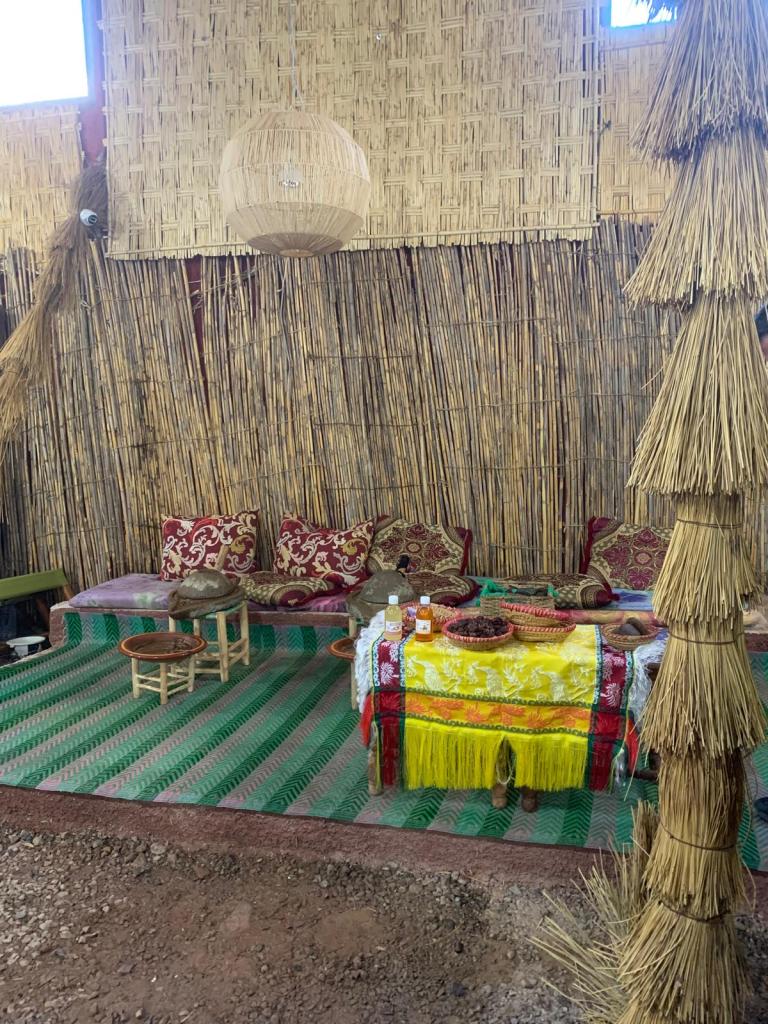
Next, we stopped at a Women’s Co-operative that make products with argan oil. The one downside for this was that I couldn’t really take part because of my allergy however, I think I would have really enjoyed it if I could. You first listen to a talk about how the oil is extracted from the nut and the nut from the flower before getting to try and smell some of their products from skincare to edible treats. The bread and dips looked especially nice and included argan mixed with honey and peanut butter. The co-operative itself is in a building that’s roof was a mixture of corrugated plastic and then branches and so, it wasn’t particularly well sealed. Expect water droplets to fall and it to be quite cold in there if you go in the winter months as we did. I imagine you would certainly not have this problem in the summer.
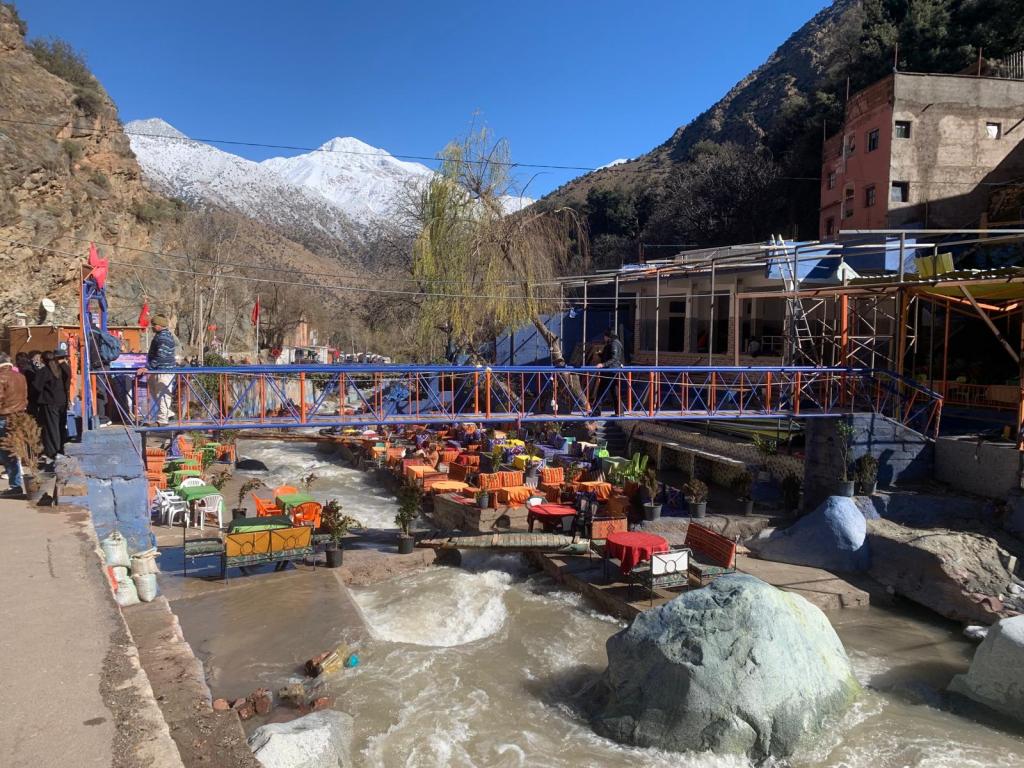
Those two initial stops are really just small additions to the trip with the main event being a trip to Setti Fadma. This is where you get the iconic cafes and restaurants alongside the river. There are seats and cushions on either side connected by wooden plank bridges and it’s an incredible setting for a lunch spot. You could book the trip with lunch included or without. We opted for lunch included and, although I didn’t have anything (again due to my allergy), Alex and the rest of our group did. The food looked great and was traditional Moroccan cuisine including tagines and couscous. According to Alex, it also tasted good and was well worth the extra fee for lunch included.
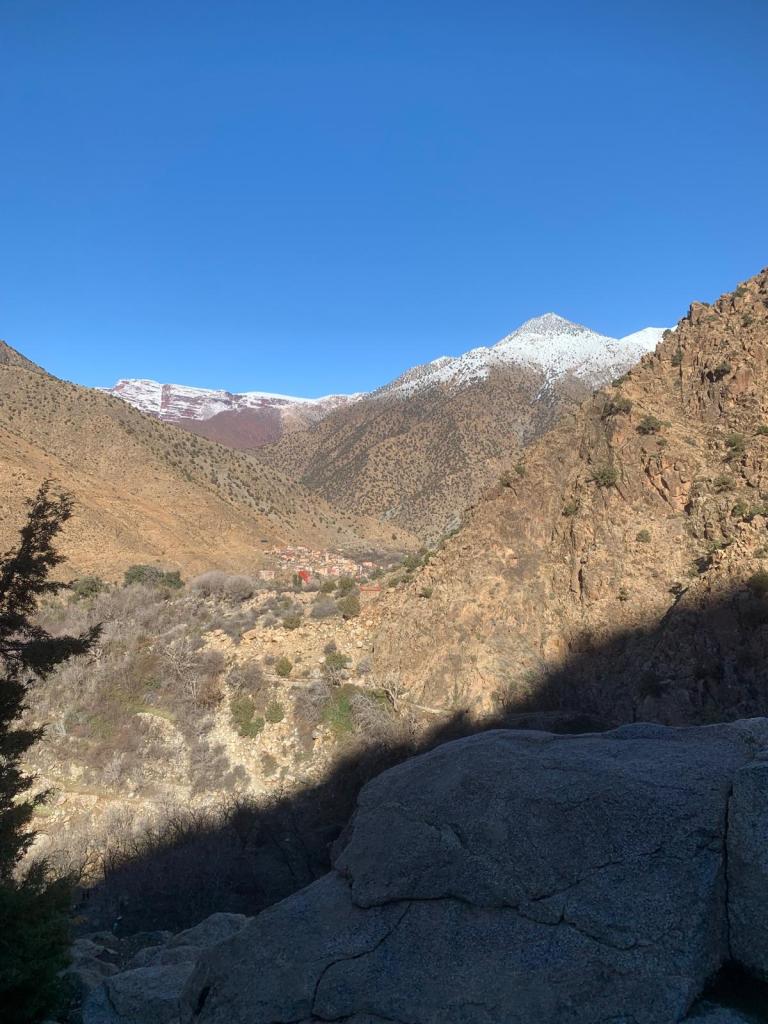
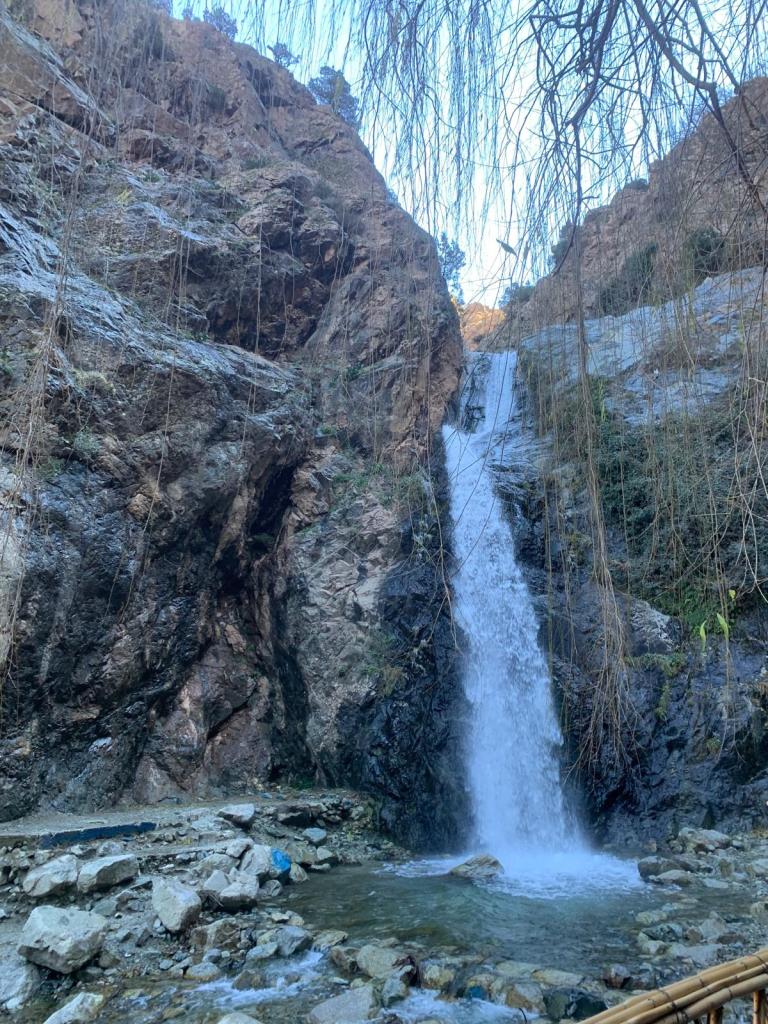
The final aspect of the trip was a ‘hike’ to the waterfall. This was nice and not too challenging. It took an hour and a half but, you take it very slowly and there are so many people doing it that you can’t really go any faster. There are lots of breaks for photographs too and this was probably my favourite part of the day. The waterfall itself is nice but the real highlight was the views of the snowy mountains in the distance and the village itself. We did this in January so there was a few icy patches but the guides are very good at helping you across any rocky areas that could prove more difficult. If you’re used to walking this will be a breeze and even if you aren’t it is perfectly manageable. It doesn’t really matter if you do lose your guide as everyone is going to and from the same place even if it’s a slightly different route. I think our route was particularly good as we took a circular route and this was much less busy on the way back down and probably slightly easier than going back the same way. I didn’t catch our guides name but he was excellent.
From there, you head back to the city. We were due to arrive back between 3 and 4pm but, it was more like 5pm when we got to Marrakesh. However, it didn’t matter too much as we still had a few hours until our sleeper train to Tangier, our next destination. Our tour guide was more than happy for us to change our drop-off destination to the train station and in fact, most of our group picked different points. One girl even got dropped off at the airport. Expect to spend quite a lot of time driving around Marrakesh for the drop offs if you’re one of the later stops as the traffic is horrendous.
All in all though, this was a great day out and I’d highly recommend adding this excursion to your trip.
What did we miss?
There are a couple of things in Marrakesh that we didn’t do in the end. One of those was a trip to the Atlas Mountains and Imlil. We originally planned to do this but, with Alex not feeling very well, we felt that it would be a mistake to go to the mountains with forecasted -16 degrees Celsius. It’s a shame but, I’d love to go back and hike up Toubkal one day so I’m sure we’ll get to see the mountains properly another time. Toubkal is the highest mountain in North Africa and one of the 4,000m+ peaks.
We also didn’t visit the Majorelle Gardens which are said to be incredibly beautiful botanic gardens that were created by an Orientalist artist, Jaques Majorelle. The gardens also contain a Cubist villa designed by another French architect, Paul Sinoir. The villa is perhaps most famous for being owned by fashion designer, Yves Saint-Laurent, who restored it and opened both the gardens and the villa to the public. When Yves Saint-Laurent passed away in 2008, his ashes were spread in the garden and in 2017, they also opened the Yves Saint-Laurent museum nearby. This does look very pretty and I can see why people visit. They are a way outside of the centre though and would require a tour, taxi or bus. Entry is around 170 dirhams for the gardens, with extra fees for the museum.
Finally, the other popular excursion is camel riding and/or quad biking. Our trip to the Atlas Mountains was going to include camel riding but, as I said, we didn’t do that in the end. It’s a shame as I think I would have enjoyed that. We did learn on our Ourika Valley tour that the ‘camels’ in Morocco aren’t actually camels at all but Dromedary. They have one hump rather than two!
That brings me to the end of our trip to Marrakesh and I did really enjoy our time in the city. Unlike other holidays where we’re running around ticking everything off, we took this a little slower as the main ‘sight’ or ‘thing to do’ is really just to immerse yourself in a different culture. If anyone is feeling apprehensive or concerned, I hope this eases your fears. My family were quite worried and kept telling me to be careful etc but, it really was completely fine. Don’t do anything silly and you’ll have a fantastic holiday.
You can have a great trip to Marrakesh and see everything you need to see in a weekend. Plus, with just a three hour flight from the UK, who could ask for anything more?
Amie x

 Explore with Amie
Leave a reply to Tanger Travel Guide | Sleeper Train, Accommodation, Things to Do and See – Explore with Amie Cancel reply