If you follow me on instagram (@explorewithamie – check it out!) – then you will know that last week, Alex and I travelled throughout Poland for five days. Our first stop of the trip was Gdansk which is a port city on the Baltic coastline of Northern Poland. It is one of the three cities that make up the Tricity region of the country, with the region having a population of around 1.5 million people and Gdansk itself sharing 472,000 of that number. I didn’t know that much about the city before the trip however, I quickly learnt that this is a city with lots of history and beautiful architecture to explore.
Airport to City

Gdansk Lech Walesa is the main airport for visitors if you are flying directly into Gdansk. Located slightly outside of the city centre, you will need to get a train from the station to Gdansk Glowny. This is incredibly easy as the station, Gdansk Port Lotniczey, is located straight across the road from the exit when you depart the airport. Helpfully, the ticket machine on the platform can be translated into English which made the process of buying a ticket very smooth. The train cost 9 zloty for a single ticket which is the equivalent of under £2 as of January 2024. It is very affordable and, in my opinion, the best way to get from the airport. Don’t be worried about using public transport whilst on holiday; it’s usually a very smooth process. Be aware that some train journeys require a change of trains whereas others are direct. You also have the option of a FlixBus from the airport too.
Things to See and Do
There is so much to see and do in Gdansk! However, I wouldn’t say that you need more than two days to see everything on this list. It is enough time to fall in love with the city and really see everything that it has to offer. You could extend the trip and visit Gdynia and in the summer, heading to the beach is a popular option. But, in terms of the city centre, I would recommend two days maximum. We managed to see everything in 24hours or so.
From the station, the best, and arguably more impressive, way to begin your tour of Gdansk is to enter the old town through the Zlota Brama. This is a historic Renaissance gate that was built during the early 1600s. Unfortunately, it was destroyed in WW2 but was rebuilt in 1957. Shortly in front of this gate is the Brama Wyzynna which was the original entrance to the city and now acts as a tourist information centre. It marks the changes in Polish history of its borders as the gate holds the symbols of Gdansk, Prussia and Poland.
Gdansk Old Town

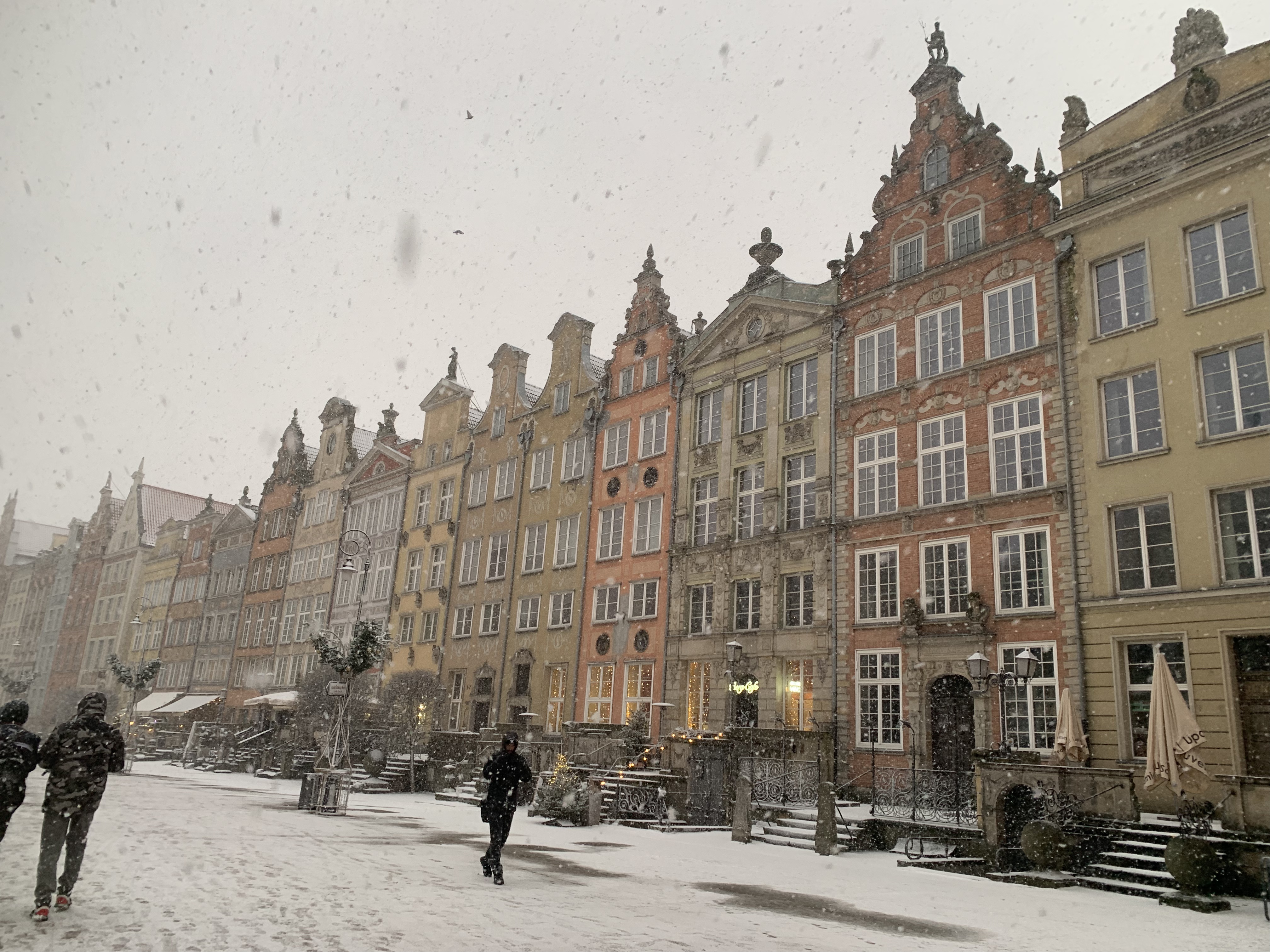
These two gates lead you straight out onto Dluga which is one of the most architecturally striking pedestrianised streets through Gdansk Old Town and therefore, it is a popular spot with tourists. The atmosphere on this street was only added to by the festivities of Christmas decorations and a layer of snow. It made us feel as if we were walking through a model village at Christmastime. You really get a sense of the city from here. Look up and around as you walk down this street; all the buildings, no matter what the function, are beautiful. Further down the road is the Town Hall which now acts as the Museum of Gdansk. We didn’t visit the museum so I cannot vouch for its quality however, tickets cost around £5. Whether you enter or not, you can’t help but appreciate this Gothic-Renaissance building as you walk down the street. Shortly past the museum the street opens out onto a long plaza known as the Long Market. One notable sight here is Neptune’s fountain, a 17th century statue and fountain which really adds to the grandeur of the place.

Another notable street within the city is Mariacka which is lovely and quaint, lined with shops selling amber and other small trinkets. It is very unusual and I would recommend having a wander around here and the surrounding streets. Gdansk is seen as the world capital of baltic amber with the largest source of amber located to the east of the city. With the right conditions, you can still find it washed up along the beaches in the area today.

One of the prominent sights in Old Town, other than walk around and admire it, is to head up to the viewpoint at the top of the Basilica. The Basillica of St Mary of the Assumption of the Blessed Virgin Mary in Gdansk, or St Mary’s Church, is a gothic cathedral that was built in 1502. It is believed that a church has been on this site since 1243 when it was simply a wooden structure. As well as a walk around the Cathedral, which is surprisingly painted fully white inside, you can pay 16 zloty to climb to the top of the tower. There are around 700 steps to climb to get to the top, some of which are in a tight spiral staircase so, this is only a sight for the able-bodied unfortunately. It was a little scary coming down! However, it is well worth it for the views you get, both as you climb the stairs through the eves of the cathedral and out onto the city once you reach the top. I have another free viewpoint to share later in this post but, I would still recommend paying to go up this one too!
Along the Motlawa River


Walking alongside the Motlawa River is a great way to see a lot of the city. You can cross the river via the Green Bridge at the end of Dluga which has incredible views of the river and the buildings that crowd its banks. The Soldeck boat, a part of the National Maritime Museum, can be found along the river. This was a freight ship used post-WW2 as you start to get hints of Gdansk maritime influence and history. It looked pretty immense in the snow too. Shortly further on from the Soldeck, you arrive at the Gdansk sign! I’m unsure if this is actually lit up anymore but, it is well worth a look and a quick photo as you pass.
On the opposite side of the river you will find the Museum of the Second World War which is free to enter on a Tuesday. I think it is very important to learn about Poland’s history, especially in the war, when visiting the country. If you’re only travelling to Gdansk, then this would be a very good place to learn more. Tickets cost 29.00 zloty which is around £6 per person. The Baszta Labedz, or Swan Tower, is another Gothic structure which crowns the river on this side. This tower used to be part of the city defences and you’re sure to pass by it at least once during your time here.
Outside of Old Town

I’ve called this portion outside of the city centre but it actually really isn’t all that far so, don’t be intimidated! As I said earlier, Gdansk is a city rich with history and I would recommend heading out to the European Solidarity Centre to learn more about the Solidarity Movement which was heavily influential in Poland gaining independence from the Soviets. The movement actually began when workers went on strike from Gdansk shipyard and graffitied a list of demands on the gates to the yard. The movement was lead by Lech Walesha, the namesake of the airport who later won a Nobel Peace prize. I was really looking forward to going to the museum and learning more about the history however, the museum was unfortunately closed to sightseers on the day we attempted to go. The gates to the shipyard and the monument to the fallen shipyard workers of 1970, located just outside of the museum, are worth a look, even if you aren’t going to the museum.

Just past the museum is the Sala BHP building which is free to enter and has an informative exhibition about the shipyard. I was very glad that we came across this so I could learn some more about the movement and the maritime history of the city. Incredibly, this is also the hall where the Gdansk Agreement was signed in August 1980 which lead to the official establishment of the trade union. Obviously, I can’t provide a comparison of the two museums but, this one was very informative and is in a very historic location.
On the way to the Solidarity museums, why not stop at the Radunia Canal for a look around? This area is very pretty for a walk around as a canal runs through the bustling city. The canal was built in the 14th century to operate a mill.

Finally, the last sight that should be on your Gdansk bucket list is the Gora Gradowa which is another scenic viewpoint behind the train station. This viewpoint features a cross sculpture which dominates the landscape. You can spot this from the Basilica viewpoint! However, you also get a great view across the city for free. Crucially, you get to see the Basilica from a distance here which highlights in magnificence. The area is also part of an old fort that acted as the cities defences. You can have a look around this area for free although, there is a museum too with interactive exhibits. The museum costs around £4 to enter.
That draws this travel guide of Gdansk to a close. It really is a wonderful city that you can spend a day or two in and really get to know. I would highly recommend travelling in January if you are able as the snowy landscape really eventuated the beauty of the city. It wasn’t hugely busy and I fell in love with it.
To answer the question, yes! Gdansk is very much worth visiting. Will you be going?
Amie x


Leave a Reply